
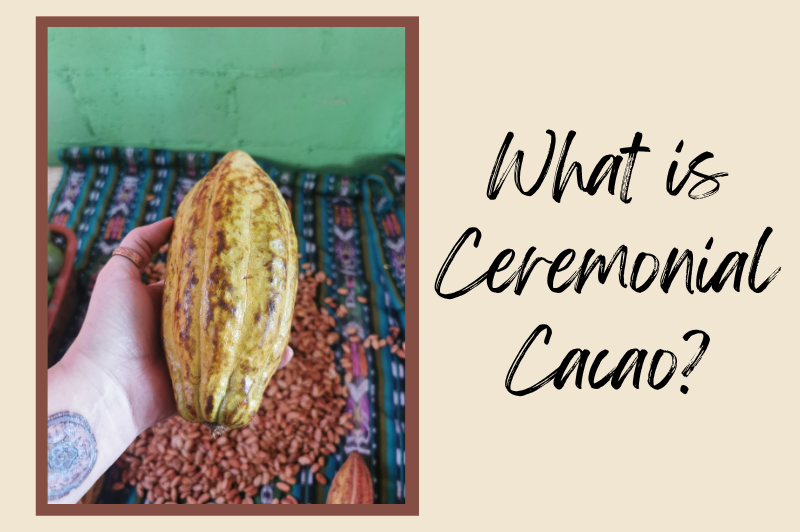
If you’ve only ever enjoyed hot chocolate or eaten chocolate bars, you might be wondering what ceremonial cacao actually is. Is it simply chocolate without sugar? Is it a health drink? Or is it something more?
The answer is surprisingly simple.
Ceremonial cacao is made from whole cacao beans that have been minimally processed to preserve as much of their natural character as possible. Unlike commercial drinking chocolate, it contains no added sugar, milk powder or artificial ingredients. Instead, it is pure cacao, usually formed into blocks or paste that can be melted into a rich, nourishing drink.
For many people, preparing ceremonial cacao becomes far more than making a warm drink. It becomes an opportunity to pause, breathe and create a moment of intention, whether that’s through meditation, journalling, creativity, yoga, sound healing or simply sitting quietly before the day begins.
Where Does Ceremonial Cacao Come From?
Cacao grows on the cacao tree (Theobroma cacao), which thrives in tropical climates close to the equator. The trees produce colourful pods, each containing rows of cacao beans surrounded by a naturally sweet white pulp.
Once harvested, the beans are removed from the pod, fermented, dried, roasted and ground into a smooth paste. Because ceremonial cacao undergoes minimal processing, it retains much of its natural flavour and many of the compounds found in the whole bean.

Why Is It Called Ceremonial Cacao?
The phrase “ceremonial cacao” has become widely recognised over the past two decades, although there is no legal definition or certification that officially makes one cacao ceremonial and another not.
The late Keith Wilson, founder of Keith’s Cacao, is widely credited with popularising the phrase. Keith believed ceremonial-grade cacao should be grown and processed using traditional methods, while showing respect for both the land and the indigenous Mayan communities who have cultivated cacao for generations.
At Earthtones, those values are one of the reasons we continue to choose Keith’s Cacao. It’s the cacao we use in every ceremony we facilitate, not simply because of its flavour and consistency, but because of the philosophy behind its production.
More Than Just a Product
Before visiting Guatemala, I understood Keith’s philosophy because I’d read about it. After spending time in San Marcos with the Keith’s Cacao team, I understood it because I’d seen it.
One of the things that struck me most was that Keith’s Cacao isn’t simply made in a Mayan community, it’s made by one.
Many of the people working in the workshop are indigenous Maya, and the knowledge behind the cacao is passed on with enormous pride.
One family beautifully illustrates this. Marcella was the very first tostadora (the person responsible for roasting the cacao beans) trained by Keith Wilson. She later trained her daughter, Candelaria, and one year ago her granddaughter, Rosalinda Sajvin, became General Manager of Keith’s Cacao Guatemala after more than eight years with the company.
Seeing three generations of one family working together was a wonderful reminder that every block of ceremonial cacao represents far more than a product. It carries years of experience, tradition and dedication.

What Does Ceremonial Cacao Taste Like?
If you’re expecting sweet hot chocolate, ceremonial cacao may come as a surprise.
It has a rich, complex flavour with notes of dark chocolate, gentle bitterness and, depending on the origin, hints of fruit, nuts or spice. Every producer has their own character, and every batch reflects the beans from which it was made.
Many people find that the flavour grows on them over time, particularly when enjoyed without large amounts of sugar.
Why Do People Drink Ceremonial Cacao?
People come to ceremonial cacao for many different reasons.
For some, it’s a mindful alternative to coffee and a way to begin the day with intention. Others enjoy it before meditation, journalling, yoga, sound healing or creative work. Many facilitators also incorporate ceremonial cacao into group circles and workshops.
Within many traditions, ceremonial cacao is regarded as a gentle plant medicine and is often described as a heart opener. Rather than changing who you are, many people find that it helps create space for reflection, honesty and connection, both with themselves and with others.
Keith Wilson, founder of Keith’s Cacao, often reminded people not to expect the cacao to do the work for them. He famously said:
“Cacao opens the door. It’s up to you to walk through it.”
I think that’s a beautiful way to understand ceremonial cacao. A cup of cacao can create an opportunity to pause, listen and reflect, but what you choose to do with that opportunity is entirely your own.
Does Ceremonial Cacao Contain Caffeine?
Yes, but probably much less than you might expect.
A ceremonial serving of Keith’s Cacao contains less than 5 mg of caffeine, which is about the same as a cup of decaffeinated coffee. By comparison, a typical cup of brewed coffee contains around 95 mg of caffeine.
What ceremonial cacao does contain is theobromine, a naturally occurring compound found in cacao. Theobromine belongs to the same family as caffeine, but many people experience it quite differently. Rather than the sharp stimulation often associated with coffee, many people describe ceremonial cacao as providing a gentler, steadier sense of alertness.
Everyone responds differently, and factors such as serving size, body weight and individual sensitivity all play a part. If you’re new to ceremonial cacao, it’s always sensible to begin with a smaller serving and see how your body responds.
How Much Should You Drink?
The amount depends on how you intend to enjoy it.
- 10–15g for an everyday cup.
- 20–28g for a longer reflective practice and sharing in ceremony.
- 28–42g for a stronger ceremonial serving for shadow work.
There’s no need to start with a ceremonial dose. Many people discover that a smaller daily cup becomes a meaningful ritual in itself.
How Do You Prepare Ceremonial Cacao?
Preparing ceremonial cacao is wonderfully simple.
Warm water or your favourite plant milk is gently heated (avoid boiling), the cacao is added, then whisked or blended until smooth. Some people enjoy adding cinnamon, vanilla or a little honey or maple syrup, while others prefer to drink it just as it is.
For more information, read our full guide to preparing Ceremonial Cacao.
Is Ceremonial Cacao Right for Everyone?
Although ceremonial cacao is simply pure cacao, it isn’t suitable for everyone in larger quantities.
If you are pregnant, have a heart condition, or take MAOI or SSRI medication, it’s sensible to speak to your healthcare professional before drinking ceremonial servings.
Ready to Experience Ceremonial Cacao?
At Earthtones, we’ve chosen Keith’s Cacao because we believe quality, integrity and respect matter.
Whether you’re looking for a mindful morning ritual, preparing for meditation, or simply curious to experience ceremonial cacao for yourself, we’d love to help you begin your journey.
You can explore our range of Keith’s Cacao, or join us at one of our regular cacao ceremonies to experience it in a welcoming, supportive environment.
Further Reading
How to Prepare Ceremonial Cacao
Discover more from Earthtones
Subscribe to get the latest posts sent to your email.


No responses yet