
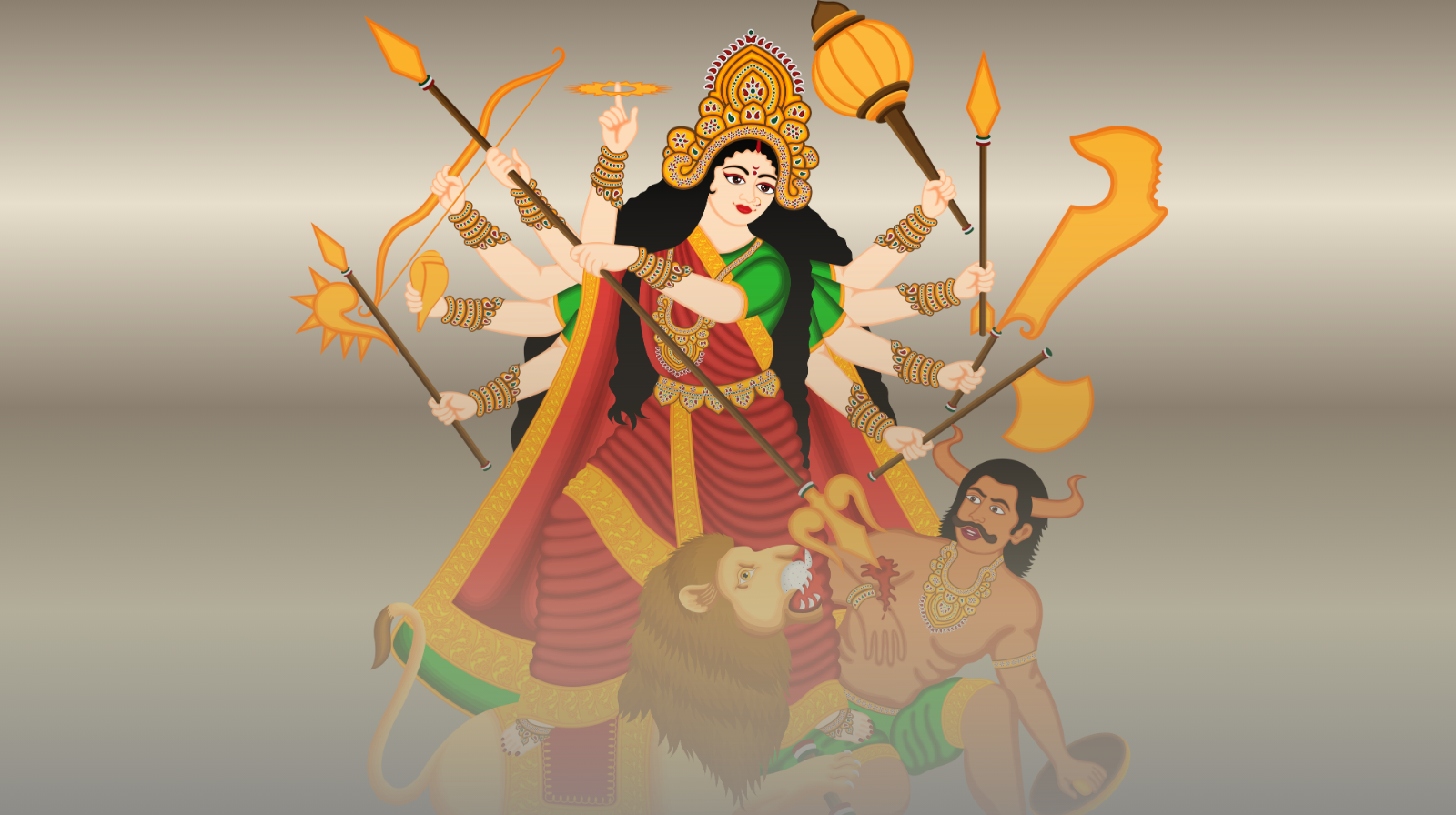
If you’ve been following the Monday Mantra section over the last couple of weeks, you’ll have seen me performing my morning devotional ritual. I choose one deity for a week, and this week has been Durga.
I have a personal relationship with Durga. She was the first Hindu deity I really connected with when I began, almost 20 years ago. I came to Hinduism through my mantra therapy training and fell in love, although I had already developed an interest in Hinduism, and the feeling that I was meant to explore it. So I felt a connection with Durga, although not the mantra we learned for her. I could take or leave the mantra then, but not Durga. She’s a mother goddess, but a fierce one. If you need courage, strength or emotional backup, she’s there. And I’ve needed that in spades over the years!
In the Hindu myths, Durga is brought into being by the gods who were unable to defeat a particular demon, to whom Brahma had granted a boon. The demon, Mahishasura, asked that no god, demon, or magical being be able to kill him. If death were ever to come to him, it should be at the hands of a woman, a request that stemmed from his belief that no woman could ever match his strength. Brahma said yes, though regretted it when Mahishasura used his new power to try to take over the three worlds. The gods came together to stop him, but were unable to, thanks to the boon.
Recognising that Mahishasura could only be defeated by a woman, the Gods decided to combine their divine energies to create a supreme female warrior. From this collective power, a radiant light emerged, and from that light, Goddess Durga was born. As she emerged, each god offered her a weapon, ensuring that she was armed with the best weapons to take on Mahishasura. With these gifts and a lion as her vehicle, Durga set off to face Mahishasura. Confident that no woman could ever defeat him, he sent his army to face her, but Durga took on the entire demon army easily. For nine days, the battle raged. Mahishasura, desperate to win, transformed into various forms—a lion, an elephant, and even a ferocious serpent—in an attempt to overpower Durga. On the tenth day, Mahishasura reverted to his buffalo form. But this time, Durga pinned him to the ground and pierced him with her Trishul, bringing an end to his reign terror. With this, good triumphed over evil, and peace was restored to the universe.
So, back to my devotional to her. You may have seen that I follow a simple formula – the emphasis on simple. This is a personal ritual at home, so I don’t need something elaborate and fancy. I just need a few minutes to connect with the Divine.
I light a tealight, and some incense. I offer a flower. I give thanks – 3 simple sentences, usually. Thanks for the breath of life, for support, and for something else that I’m especially grateful for at the moment.
Then I chant a mala of a mantra. For Durga, I used the one I learned nearly 20 years ago:
Om Dum Durgayai Namaha
There are a few translations of this, as we don’t tend to translate Sanskrit mantras literally, but as more of an intention. I particularly like thinking of this one as “Bless me with your protection and love“. Durga is a protector against negative forces (well, she would be, wouldn’t she, after battling Mahishasura?)
Then, I sang one śloka (verse) of the Devi Mahatmya, fifteen times. The Devi Mahatmya is a philosophical text about the goddess which has 700 ślokas! However, there is a subset which praise Durga as the omnipresent force of the universe. They map the goddess into all aspects of existence, where she embodies different virtues and states in every living being. They mostly follow the same format, changing only one word each time – the aspect of existence she resides in. This is the one I used:
Ya Devi Sarva Bhuteshu
Shakti Rupena Samsthita
Nama stasyei Nama stasyei
Nama stasyei Namo Namaha
I bow to the Great Goddess who exists in all beings in the form of power.
After this, I dedicate my actions for the day to the Divine, chant five rounds of the mantra
Lokah Samastah Sukhino Bhavantu
May all beings everywhere be happy and free
And that’s it. I bow, and apply my tilak – which for me is some white sandalwood paste in small, vaguely circle shape between my eyebrows, and a small vertical line of kumkum powder (vermillion powder).
And then I go about my day, with my head a little less chaotic then before, and my capacity for dealing with life slightly extended. Fin
Discover more from Earthtones
Subscribe to get the latest posts sent to your email.


2 Responses
Gorgeous! And thanks for the expansion of practice… I’m learning so much more and deepening my own faith x
I’m so happy you’re finding it useful! From my own experience, my advice would be not to expect too much from yourself too soon. Don’t force things that don’t make sense to you, just embrace the deepening as it happens naturally (which I suspect is what you would do anyway!)